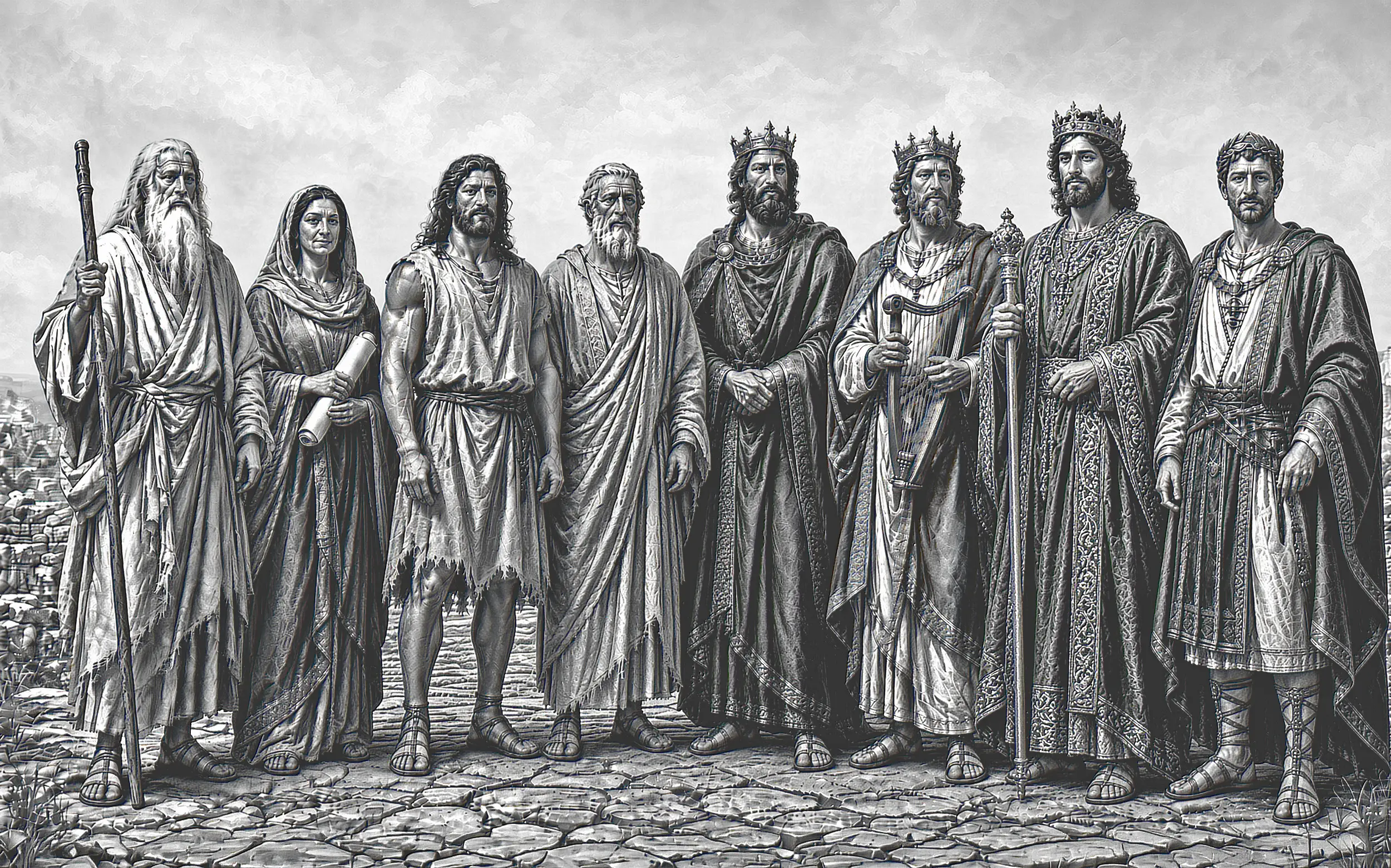
Illustration by Fiki. ©2026 ISI.BIBLE
Then all the elders of Israel gathered together and came to Samuel at Ramah; and they said to him, “Behold, you have grown old, and your sons do not walk in your ways. Now appoint a king for us to judge us like all the nations. – 1 Samuel 8:4–5
As one is reading and studying the Old Testament, it can be helpful to have an understanding of the timeline and progression of the kings of Israel, encompassing the period from the Exodus/Moses (c. 1446 BC) all the way to Messiah (Jesus the Christ; 6–4 BC onwards).1 While this study is titled the “Kings of Israel,” it encompasses the following:
- Exodus leaders (Moses & Joshua; c. 1446–1375 BC),
- Judges (c. 1367–1020 BC),
- Kings of the Unified Monarchy, Northern, and Southern Kingdoms (c. 1050–586 BC), and
- Foreign appointed governors/rulers after their return from exile in Babylon (586BC–33AD).
Since Israel was a theocracy, you may also like our companion study, “Priests of Israel.”
This study is also available in PDF format.
SOURCE MATERIAL
The material is drawn from the books of Exodus, Deuteronomy, Joshua, Judges, 1 Samuel, 1–2 Kings, 1–2 Chronicles, Ezra, and Nehemiah, as well as from extra-biblical sources which are deemed reputable.2, 3 Dates follow standard (traditional/conservative) chronologies and should be considered approximate in most cases.
EXODUS PERIOD (c. 1446–1375 BC)
Technically, while I have Moses and Joshua listed as the leaders here, however the Lord Himself was their God for they were His kingdom (Exo 15:18; 19:5–8; 20:2; 23:23; 32:34). Some are of the opinion, as am I, that this was the preincarnate Christ.
|
Leader |
Dates |
Verses |
Notes |
|
Moses |
c. 1446–1406 BC |
Exo 3–Deu 34 |
Led the Exodus and wilderness years |
|
Joshua |
c. 1406–1375 BC |
Jos 1–24; Jdg 2:6–9 |
Conquest and settlement of the Holy Land |
JUDGES PERIOD (c. 1367–1020 BC)
The time of the judges was by and large a time of great lawlessness, confusion, and anarchy—as it is written, “In those days there was no king in Israel; every man did what was right in his own eyes” (see Jdg 17:6; 21:25; cf. Jdg 18:1; 19:1)—apart from the specific Judges who were raised up and the deliverance/restoration they temporarily provided.
|
Judge |
Dates |
Verses |
Notes |
|
Othniel |
c. 1367–1327 BC |
Jdg 3:7–11 |
Delivered from Cushan-rishathaim of Mesopotamia |
|
Ehud |
c. 1309–1229 BC |
Jdg 3:12–30 |
Delivered from Eglon of Moab |
|
Shamgar |
(dates uncertain) |
Jdg 3:31 |
Struck down 600 Philistines |
|
Deborah (and Barak) |
c. 1237–1197 BC |
Jdg 4–5 |
Delivered from Jabin of Canaan and Sisera |
|
Gideon (Jerubbaal) |
c. 1191–1151 BC |
Jdg 6–8 |
Delivered from the Midianites |
|
Abimelech |
c. 1151–1148 BC |
Jdg 9 |
Ruled violently in Shechem (not a deliverer judge) |
|
Tola |
c. 1148–1125 BC |
Jdg 10:1–2 |
Judged 23 years |
|
Jair |
c. 1125–1103 BC |
Jdg 10:3–5 |
Judged 22 years |
|
Jephthah |
c. 1103–1097 BC |
Jdg 10:6–12:7 |
Delivered from the Ammonites |
|
Ibzan |
c. 1097–1090 BC |
Jdg 12:8–10 |
Judged 7 years |
|
Elon |
c. 1090–1080 BC |
Jdg 12:11–12 |
Judged 10 years |
|
Abdon |
c. 1080–1072 BC |
Jdg 12:13–15 |
Judged 8 years |
|
Samson |
c. 1075–1055 BC |
Jdg 13–16 |
Fought the Philistines |
|
Transition to the Monarchy |
|||
|
Eli |
c. 1100–1060 BC |
1Sa 1–4 |
High priest and judge |
|
Samuel |
c. 1060–1020 BC |
1Sa 1–25 |
Last major judge/prophet; anointed Saul and David |
KINGS PERIOD (MONARCHY, c. 1050–586 BC)
The period of having human kings over Israel (as in a Monarchy) began when they became dissatisfied with their terrible conditions (which resulted from their own behavior and also from having largely ignored the Lord during the period of the Judges) and asked for a king. They also wanted to be like the other heathen nations around them:
Then all the elders of Israel gathered together and came to Samuel at Ramah; and they said to him, “Behold, you have grown old, and your sons do not walk in your ways. Now appoint a king for us to judge us like all the nations.” But the thing was displeasing in the sight of Samuel when they said, “Give us a king to judge us.” And Samuel prayed to the Lord. The Lord said to Samuel, “Listen to the voice of the people in regard to all that they say to you, for they have not rejected you, but they have rejected Me from being king over them. Like all the deeds which they have done since the day that I brought them up from Egypt even to this day—in that they have forsaken Me and served other gods—so they are doing to you also. Now then, listen to their voice; however, you shall solemnly warn them and tell them of the procedure of the king who will reign over them.”
So Samuel spoke all the words of the Lord to the people who had asked of him a king. He said, “This will be the procedure of the king who will reign over you: he will take your sons and place them for himself in his chariots and among his horsemen and they will run before his chariots. He will appoint for himself commanders of thousands and of fifties, and some to do his plowing and to reap his harvest and to make his weapons of war and equipment for his chariots. He will also take your daughters for perfumers and cooks and bakers. He will take the best of your fields and your vineyards and your olive groves and give them to his servants. He will take a tenth of your seed and of your vineyards and give to his officers and to his servants. He will also take your male servants and your female servants and your best young men and your donkeys and use them for his work. He will take a tenth of your flocks, and you yourselves will become his servants. Then you will cry out in that day because of your king whom you have chosen for yourselves, but the Lord will not answer you in that day.”
Nevertheless, the people refused to listen to the voice of Samuel, and they said, “No, but there shall be a king over us, that we also may be like all the nations, that our king may judge us and go out before us and fight our battles.” – 1Sa 8:4–20
The succession of kings for both the unified Israel and the Northern and Southern Kingdoms is listed below. While Israel started out as a unified monarchy under Kings Saul, David, and Solomon, it later split (c. 931/930 BC) into the Northern Kingdom of Israel (Ephraim) and the Southern Kingdom of Judah. The separation was prompted by Rehoboam’s refusal to lighten the heavy burdens imposed by Solomon (see 1Ki 12:1–20). The Northern Kingdom (c. 931–722 BC) was conquered by the Assyrians in 722 BC. The Southern Kingdom (c. 931–586 BC) was conquered by the Babylonians in 586 BC, with the destruction of the temple Solomon built.
UNITED MONARCHY (c. 1050–931 BC)
|
King |
Dates |
Verses |
Notes |
|
Saul |
c. 1050–1010 BC |
1Sa 9–31; 1Ch 10 |
Disobeyed God (1Sa 13:8–14; 15:1–23, 28) |
|
Ish-bosheth |
c. 1010–1008 BC |
2Sa 2–4 |
Brief reign (~2 years); likely a weak ruler under Abner. Assassinated by two of his own captains, Baanah and Rechab (2Sa 4:5–12). |
|
David |
c. 1010–970 BC |
1Sa 16–31; 2Sa; |
A man after God’s heart (1Sa 13:14; Act 13:22) |
|
Solomon |
c. 970–931 BC |
1Ki 1–11; 2Ch 1–9 |
The king of wisdom (1Ki 3:5–14) |
NORTHERN KINGDOM OF ISRAEL (EPHRAIM) (c. 931–722 BC)
Almost every king of the Northern Kingdom is explicitly said to have “done evil in the sight of the Lord”; these kings are noted. Generally speaking, the Northern Kingdom furiously and relentlessly chased after idols and idolatry and disobeying the law (commandments) of the Lord. Hence, it was conquered first by foreigners, with the consequences of disobedience being exactly as the Lord had warned them (Deu 4:25–28; 28:15, 36–37, 63–68; 29:24–28; 31:16–18).
|
King |
Dates |
Verses |
Notes |
|
Jeroboam I |
c. 931–910 BC |
1Ki 11:26–14:20; 2Ch 10 |
Did evil |
|
Nadab |
c. 910–909 BC |
1Ki 15:25–31 |
Did evil |
|
Baasha |
c. 909–886 BC |
1Ki 15:32–16:7 |
Did evil |
|
Elah |
c. 886–885 BC |
1Ki 16:8–14 |
Did evil |
|
Zimri |
885 BC (7 days) |
1Ki 16:15–20 |
Did evil |
|
Omri (rival Tibni) |
c. 885–874 BC |
1Ki 16:21–28 |
Did evil |
|
Ahab |
c. 874–853 BC |
1Ki 16:29–22:40 |
Did evil |
|
Ahaziah |
c. 853–852 BC |
1Ki 22:51–53; 2Ki 1 |
Did evil |
|
Jehoram (Joram) |
c. 852–841 BC |
2Ki 3:1–9:26 |
Did evil |
|
Jehu |
c. 841–814 BC |
2Ki 9–10 |
Did evil |
|
Jehoahaz |
c. 814–798 BC |
2Ki 13:1–9 |
Did evil |
|
Jehoash (Joash) |
c. 798–782 BC |
2Ki 13:10–25; 14:8–16 |
Did evil |
|
Jeroboam II |
c. 793–753 BC |
2Ki 14:23–29 |
Did evil |
|
Zechariah (Zachariah) |
753 BC (6 months) |
2Ki 15:8–12 |
Did evil |
|
Shallum |
752 BC (1 month) |
2Ki 15:13–15 |
Did evil |
|
Menahem |
c. 752–742 BC |
2Ki 15:16–22 |
Did evil |
|
Pekahiah |
c. 742–740 BC |
2Ki 15:23–26 |
Did evil |
|
Pekah |
c. 752–732 BC |
2Ki 15:27–31 |
Did evil |
|
Hoshea |
c. 732–722 BC |
2Ki 17 |
Did evil |
SOUTHERN KINGDOM OF JUDAH (c. 931–586 BC)
The kings are mentioned positively (“did what was right in the sight of the Lord”) and negatively (“done evil in the sight of the Lord”) in Scripture are noted. In summary, the Southern Kingdom teetered back and forth between following the Lord (and His commandments) versus pursuing evil, idols, and idolatry.
|
King |
Dates |
Verses |
Notes |
|
Rehoboam |
c. 931–913 BC |
1Ki 12; 14:21–31; 2Ch 10–12 |
Did evil |
|
Abijah (Abijam) |
c. 913–911 BC |
1Ki 15:1–8; 2Ch 13 |
Did evil |
|
Asa |
c. 911–870 BC |
1Ki 15:9–24; 2Ch 14–16 |
Did right |
|
Jehoshaphat |
c. 870–848 BC |
1Ki 22:41–50; 2Ch 17–20 |
Did right |
|
Jehoram (Joram) |
c. 848–841 BC |
2Ki 8:16–24; 2Ch 21 |
Did evil |
|
Ahaziah |
841 BC |
2Ki 8:25–29; 9:21–28; 2Ch 22:1–9 |
Did evil |
|
Athaliah (Queen) |
c. 841–835 BC |
2Ki 11:1–16; 2Ch 22:10–23:15 |
Did evil |
|
Joash (Jehoash) |
c. 835–796 BC |
2Ki 11:17–12:21; 2Ch 23:16–24:27 |
Did right 4 |
|
Amaziah |
c. 796–767 BC |
2Ki 14:1–22; 2Ch 25 |
Did both |
|
Uzziah (Azariah) |
c. 792–740 BC |
2Ki 15:1–7; 2Ch 26 |
Did right |
|
Jotham |
c. 750–735 BC |
2Ki 15:32–38; 2Ch 27 |
Did right |
|
Ahaz |
c. 735–715 BC |
2Ki 16; 2Ch 28 |
Did evil |
|
Hezekiah |
c. 715–686 BC |
2Ki 18–20; 2Ch 29–32 |
Did right |
|
Manasseh |
c. 697–642 BC |
2Ki 21:1–18; 2Ch 33:1–20 |
Did evil5 |
|
Amon |
c. 642–640 BC |
2Ki 21:19–26; 2Ch 33:21–25 |
Did evil |
|
Josiah |
c. 640–609 BC |
2Ki 22–23:30; 2Ch 34–35 |
Did right |
|
Jehoahaz (Shallum) |
609 BC (3 months) |
2Ki 23:31–34; 2Ch 36:1–4 |
Did evil |
|
Jehoiakim (Eliakim) |
c. 609–598 BC |
2Ki 23:34–24:7; 2Ch 36:5–8 |
Did evil |
|
Jehoiachin (Jeconiah, Coniah) |
598–597 BC (3 months) |
2Ki 24:8–17; 25:27–30; 2Ch 36:9–10 |
Did evil |
|
Zedekiah (Mattaniah) |
c. 597–586 BC |
2Ki 24:18–25:21; 2Ch 36:11–21 |
Did evil |
EXILE PERIOD (605–538/536 BC)
The Babylonian conquest of Judah (Southern Kingdom) and subsequent deportations occurred in stages:
- First deportation under Nebuchadnezzar (c. 605 BC); this included Daniel and others (Dan 1:1–6).
- Second deportation (c. 597 BC); this included Jehoiachin and many others (2Ki 24:10–16).
- Final exile and temple destruction (c. 586 BC) (2Ki 25:1–12, 21).
The Jews were permitted to return to Jerusalem by Cyrus (c. 538/536 BC). This included Zerubbabel (governor of Judah, a descendant of David) and Joshua (also called Jeshua, the high priest) (Ezr 1:1–4). The returns also occurred in stages:
- First return (c. 538/536 BC)—under Sheshbazzar and Zerubbabel (with Joshua the high priest). This group began rebuilding the temple (Ezr 1–6).
- Second return (c. 458 BC)—under Ezra the scribe, who focused on teaching the Law and reforming the community (Ezr 7–10).
- Third return (c. 445 BC)—under Nehemiah, who rebuilt the walls of Jerusalem (Neh 1–7).
It was approximately 48–50 years from the fall of Jerusalem (586 BC) to the return (538/536 BC). The prophetic 70 years (Jer. 25:11–12; 29:10) is commonly aligned with either from the first deportation (605 BC) to the return (c. 536 BC), or from the fall of Jerusalem (586 BC) to the completion of the second temple (516 BC).6
During the exile period, Babylon appointed rulers over Jerusalem:
|
Governor |
Dates |
Verses |
Notes |
|
Gedaliah |
c. 586 BC |
2Ki 25:22–26; Jer 40–41 |
Appointed by Nebuchadnezzar over the remnant left in the land. Governed from Mizpah. Assassinated by Ishmael of the royal family. |
POST EXILE PERIOD (538/536 BC–33 AD)
Upon their return to Jerusalem, the remnant was called Jews (Yehudim). In the Books of Ezra–Nehemiah, the biblical writers still sometimes use “Israel” or “the people of Israel” for the returnees, but the actual political and administrative entity was the Persian province of Yehud, centered on Jerusalem. It was no longer a kingdom and no longer encompassed the former northern tribes.
PERSIAN PERIOD (c. 539/538–332 BC)
Information for this period is known only from seals, jar impressions, coins, and the Elephantine papyri. The full sequence is not completely known; there are gaps between the major figures. Most governors appear to have been Jewish (often from prominent families), consistent with Persian practice of using local leaders. Zerubbabel and Sheshbazzar are the only ones of clear Davidic descent; the monarchy itself was not restored.
|
Governor |
Dates |
Verses |
Notes |
|
Sheshbazzar |
c. 538 BC |
Ezr 1:8; 5:14 |
Prince of Judah; led the first return and received the temple vessels from Cyrus. Possibly of Davidic descent. |
|
Zerubbabel |
c. 520–510 BC |
Hag 1:1; Ezr 3; Zec 4
|
Davidic descendant (grandson of Jehoiachin); led the rebuilding of the temple with Joshua the high priest. |
|
Elnathan |
Early 5th century BC |
n/a |
Known from seals and jar impressions. |
|
Yehoezer (Jehoezer) |
|
n/a |
Known from seals. |
|
Ahzai |
|
n/a |
Known from seals. |
|
Nehemiah |
c. 445–433 BC |
Neh 1–13 |
Appointed by Artaxerxes I; rebuilt Jerusalem’s walls and served as governor. |
|
Bagohi |
Late 5th century BC |
n/a |
Mentioned in the Elephantine papyri as governor of Judah. |
|
Yehezqiyah |
Late 4th century BC |
n/a |
Known from coins inscribed “Yehezqiyah the governor.” |
After the Persian period (332 BC onward), Judah passed under Greek (Ptolemaic then Seleucid) rule, eventually leading to the Hasmonean period.
HELLENISTIC PERIOD (c. 332–167 BC)
Under Ptolemies then Seleucids. Local administration continued, but few named Jewish governors are clearly attested until the Maccabean period. High priests (e.g., Onias family) held significant influence.
HASMONEAN PERIOD (c. 167–37 BC)
Priestly family that led the revolt against the Seleucids and eventually ruled as ethnarchs/kings + high priests:
|
Ethnarch/King |
Dates |
Verses |
Notes |
|
Judas Maccabeus |
c. 167–160 BC |
n/a7 |
Rebel leader. |
|
Jonathan |
c. 160–142 BC |
n/a |
High priest from 152. |
|
Simon Thassi |
c. 142–134 BC |
n/a |
Ethnarch and high priest; practical independence. |
|
John Hyrcanus I |
134–104 BC |
n/a |
Ethnarch/high priest. |
|
Aristobulus I |
104–103 BC |
n/a |
First to take the title “king.” |
|
Alexander Jannaeus |
103–76 BC |
n/a |
King and high priest. |
|
Salome Alexandra (Queen) |
76–67 BC |
n/a |
|
|
Hyrcanus II |
67–66 and 63–40 BC |
n/a |
King/high priest/ethnarch (interrupted). |
|
Aristobulus II |
66–63 BC |
n/a |
|
|
Antigonus II |
40–37 BC |
n/a |
Last Hasmonean king (Parthian-backed). |
ROMAN / HERODIAN PERIOD (from 63 BC onward)
Rome intervened in 63 BC. Client rulers are listed below.8
|
Client Ruler (King, Ethnarch, Tetrarch) |
Dates |
Verses |
Notes |
|
Herod the Great |
37–4 BC |
Mat 2:1–22 (the Magi, the massacre of the infants, and the flight to Egypt) |
Roman-appointed king of Judea (Idumean, not Davidic or Hasmonean by birth; married into the Hasmonean family). |
|
Herod Archelaus |
4 BC–AD 6 |
Mat 2:22 (Joseph is afraid to return to Judea because Archelaus is ruling there) |
Ethnarch of Judea, Samaria, Idumea (deposed; replaced by Roman prefects and procurators). |
|
Herod Antipas |
4 BC–AD 39 |
Mat 14:1–12; Mar 6:14–29; Luk 3:19–20; 9:7–9 (imprisonment and death of John the Baptist) Luk 13:31–32 (Jesus refers to him as “that fox”) Luk 23:6–12 (Jesus sent to him during the trial) Act 4:27 (listed among those who opposed Jesus) |
Tetrarch of Galilee and Perea. |
|
Philip the Tetrarch |
4 BC–AD 34 |
Luk 3:1 (mentioned in the dating of John the Baptist’s ministry) |
Tetrarch of the northeast territories. |
|
Herod Agrippa I |
AD 41–44 |
Act 12:1–23 (persecution of the church, death of James, imprisonment of Peter) |
King of a reunited Judea for a short time. |
|
Herod Agrippa II |
AD 48–c. 100 |
Act 25:13–27; 26:1–32 (Paul’s defense before Agrippa and Festus) |
Ruler of smaller territories in the north. |
After Archelaus was removed in AD 6, Judea proper was usually governed directly by Roman prefects or procurators until the First Jewish Revolt (AD 66–73) and the destruction of the Second Temple (AD 70).
|
Prefect/Procurator |
Dates |
Verses |
Notes |
|
Pontius Pilate |
AD 26–36 |
Mat 27; Joh 18–19 |
Roman prefect of Judea; presided over Jesus’ trial. |
|
Felix |
AD 52–58/59 |
Act 23:24–26; 24:1–27 |
Roman procurator of Judea. Held Paul in custody at Caesarea and heard his defense; hoped for a bribe and left him imprisoned. |
|
Festus |
AD 59/60–62 |
Act 24:27; 25:1–27; 26:1–32 |
Roman procurator of Judea. Heard Paul’s case and sent him to Caesar after Paul’s appeal. |
Summary of the shifts: Babylonian/Persian governors → Hellenistic administration → Hasmonean independent/semi-independent rule → Roman client kings (Herodians) and direct Roman governors (Pilate). The independent earthly Davidic monarchy ended in 586 BC and was never restored as a political kingdom. It was fulfilled in Jesus the Christ and Messiah, the eternal Son of David, and King of the Kingdom of God.
MESSIANIC PERIOD (33 AD–∞)
Jesus of Nazareth—the Christ of God and the Messiah—serves as both King and High Priest over the eternal Kingdom of God/Kingdom of Heaven. We are not to look for another Messiah, earthly kingdom, or heavenly kingdom still yet to come.
|
King |
Dates |
Verses |
Notes |
|
Jesus |
c. 33 AD–∞ |
Mat 4:17; Act 1:6–11; 2:1–13 |
The Kingdom of God (Kingdom of Heaven). Jesus Born: 6–4 BC. Ministry begins / “kingdom is at hand”: AD 27–29. Crucified: AD 30 or 33 (most favor 33). |
For completeness, the Roman emperors corresponding to this period were as follows:
|
Emperor |
Dates |
Verses |
Notes |
|
Augustus |
27 BC–AD 14 |
Luk 2:1 |
The census decree. |
|
Tiberius |
AD 14–37 |
Luk 3:1 |
Dated the start of John the Baptist’s ministry. |
|
Caligula (Gaius) |
AD 37–41 |
n/a |
|
|
Claudius |
AD 41–54 |
Act 11:28; 18:2 |
The famine and the expulsion of Jews from Rome. |
|
Nero |
AD 54–68 |
n/a |
His reign covers Paul’s later ministry, the writing of several epistles, and the beginning of the First Jewish Revolt (AD 66). |
|
Vespasian |
AD 69–79 |
n/a |
The general who began the campaign against Jerusalem and later became emperor when the Temple was destroyed (AD 70). |
|
Titus |
AD 79–81 |
n/a |
Vespasian’s son and general, he completed the siege and destruction of Jerusalem and the Temple in AD 70. |
CLOSING REMARKS
One can surmise by reading through all these periods just how much turmoil there was throughout the land and how bad things had gotten with endless wars, idolatry, immorality, lawlessness, treachery, corruption, foreign conquest, and so on, and so the people eagerly waited for a deliverer who was to restore the nation (both politically and spiritually)—the Messiah to come (Gen 49:10; Num 24:17; 2Sa 7:12–16; Psa 89:3–4, 28–37; Isa 7:14; 9:6–7; 11:1–10; 53; Dan 7:13–14; Mic 5:2; Zec 9:9)—only to reject Him when He came due to a gross lack of understanding as to the spiritual nature of the kingdom He was to usher in.
They expected the coming Messiah (i.e., Jesus) to re-establish a physical, earthly, nationalistic, political, monarchic kingdom here on earth (Hos 6:11; Jol 3:1; Mat 20:20–23; 21:9; 21:15; Mar 10:35–40; 11:9–10; Joh 12:13; Act 1:6). The very same mistake is being made again today in large majority, even by professing Christians who have succumbed to the errant Dispensational Premillennialism theological/prophetic framework.9
Suggested follow-up studies are listed below:
- Priests of Israel,
- Prophets of Israel,
- Books of the Bible: Dating and Authorship,
- The Kingdom of God,10 and our book
- The Last Day—which covers kingdom topics from an end-times prophecy (eschatological) perspective.
1 The opening illustration should be considered artistic, not literal. We know very little of what most people in the Bible actually looked like (including Jesus) outside of some very general descriptions, some tidbits about their dress, and a general knowledge of biblical times, dress, and customs.
2 Non-Biblical Sources, primarily for post 586 BC material:
- Antiquities of the Jews—Josephus, Flavius. Jewish Antiquities. Translated by H. St. J. Thackeray, Ralph Marcus, Allen Wikgren, and Louis H. Feldman. Loeb Classical Library. Harvard University Press, 1930–1965.
- 1 and 2 Maccabees—The New Oxford Annotated Bible with Apocrypha, edited by Michael D. Coogan et al. Oxford University Press, 2018. [1 Maccabees 1:1–16:24; 2 Maccabees 1:1–15:39; NRSV or other preferred translation]
- Elephantine Papyri—Bezalel Porten and Ada Yardeni, Textbook of Aramaic Documents from Ancient Egypt, 4 vols. (Hebrew University, 1986–1999).
- Stamp Impressions—Lipschits, Oded, and David S. Vanderhooft. The Yehud Stamp Impressions: A Corpus of Inscribed Impressions from the Persian and Hellenistic Periods in Judah. Eisenbrauns, 2011. [for Persian governors via seals/coins]
3 The post-586 BC material sources are as follows (continues in next page footnotes).
- Derived from biblical sources:
- Gedaliah (2Ki 25; Jer 40–41)
- Sheshbazzar, Zerubbabel, and Nehemiah (the Books of Ezra and Nehemiah)
- The general outline of the return and the Persian period derived from those books
- Derived from extra-biblical sources
- The additional Persian governors (Elnathan, Yehoezer, Ahzai, Bagohi/Bagoas, Yehezqiyah/Hezekiah)—known mainly from seal impressions, coins, and the Elephantine papyri
- The full Hasmonean sequence and dates—primarily the Books of 1–2 Maccabees and Josephus (Antiquities of the Jews)
- The Herodian rulers and the Roman prefects/procurators—Josephus and other Greco-Roman historical sources
4 Did good in his early years.
5 Received one of the strongest condemnations in Scripture.
6 There is no “missing week of years” as those who advocate “Dispensational Premillennialism” wrongly claim. See our book The Last Day.
7 Hasmonean rulers (Judas Maccabeus through Antigonus II) appear in 1–2 Maccabees and Josephus, but not in the Protestant canon.
8 Client rulers (king, ethnarch, tetrarch; e.g., Herod the Great) were local or semi-local leaders whom Rome allowed to govern a territory as subordinates. They had a degree of internal authority (collecting taxes, maintaining order, limited judicial power) but answered to Rome and could be removed or replaced at any time. The Herods are the classic example: they were not fully independent kings, but Rome-appointed client rulers over parts of the former Hasmonean territory. A Prefect (later often called procurator, e.g. Pontius Pilate) was a direct Roman official. He was a Roman citizen appointed by the emperor (or by the governor of Syria) to administer a province or territory. He represented Roman authority more immediately, handled major judicial cases (especially those involving capital punishment), and oversaw the Roman military presence.
9 A set of fake prophecies all woven together into a giant web of confusion.
10 → [The Kingdom of God]