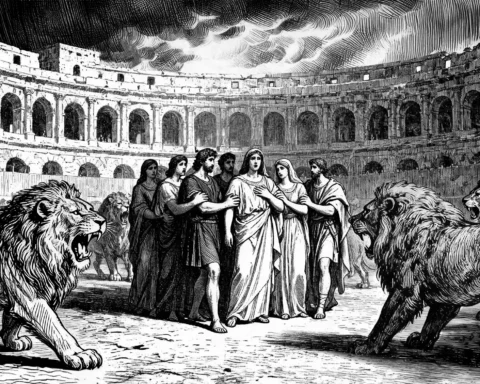
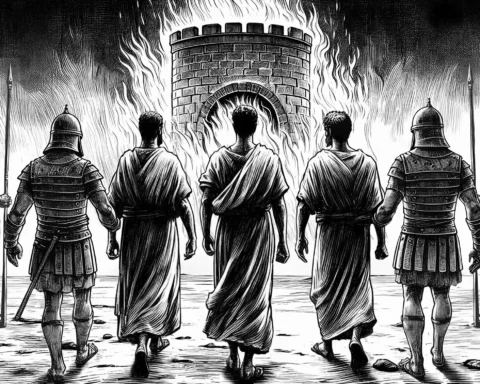
Illustration by Fiki. ©2025 ISI.BIBLE
So they went on their way from the presence of the Council, rejoicing that they had been considered worthy to suffer shame for His name. – Acts 5:41
Also in the Book of Acts, we read about the apostles in prison (Act 5:12–42). This incident occurred shortly after the death, resurrection, and ascension of Jesus in Jerusalem. The apostles were preaching the Gospel and performing “many signs and wonders [i.e., healings]” (v. 12), and “more believers in the Lord, multitudes of men and women, were constantly added to their number” (v. 14). As was often the case when Jesus was alive, the religious rulers1 “were filled with jealousy. They laid hands on the apostles and put them in a public jail” (vv. 17–18). We then read that the apostles were miraculously released from prison by “an angel of the Lord” (v. 19), and they immediately went out again and continued preaching “the whole message of this Life [i.e., the Gospel of Jesus Christ]” (vv. 20–21a).
Subsequently, they were rearrested (vv. 21b–26), and the Jewish council reprimanded them again for teaching in the name of Jesus (v. 28). But Peter responded, “We must obey God rather than men” (v. 29). The apostles thus demonstrated that they were firm in their faith and not dismayed, alarmed, worried, or anxious about what was happening to them. They were simply following (and would keep following) the commandments of Christ. If the Law of Christ conflicts with the laws of man, we must obey our Lord and King (Christ).
This treatment was typical of the persecution the early Christians had come under at that time. However—and we’re getting to the part that is inspirational and anxiety-busting—Peter’s response and mini-sermon (vv. 30–32) again enraged the religious rulers and caused another commotion. The result was that the apostles were flogged (v. 40) and then released, at which point, “they went on their way from the presence of the Council, rejoicing that they had been considered worthy to suffer shame for His name” (v. 41). Then they went on preaching the Gospel afterward yet again!
It’s easy to miss the part that I find truly inspirational in all this. Not only is it the apostles’ determination to follow God over men when there is a conflict,2 but it is also their attitude of “rejoicing” after being “flogged.”
It’s easy to quickly read over that part like it’s no big deal. However, while it’s not as extreme as scourging, during which your flesh is actually ripped off your back, flogging is still extremely painful. The whipping process hurts greatly; it can tear open your flesh, and if done too much, it can lead to death. I’ve never been flogged, nor do I want to be. I hope I can endure such pain and “stand firm”3 like these men of faith did. I trust that the Lord will help me (and all of us) endure such treatment as needed and according to His will and for His glory and, even further, help us have the same attitude during such a difficult experience (v. 41).4
Matthew Henry writes on verses 40–42: [3]
The wonderful courage and constancy of the apostles in the midst of all these injuries and indignities done them. When they were dismissed they departed from the council, and we do not find one word they said by way of reflection upon the court and the unjust treatment given them. When they were reviled they reviled not again; and when they suffered they threatened not; but committed their cause to him to whom Gamaliel had referred it, even to a God who judgeth righteously. All their business was to preserve the possession of their own souls, and to make full proof of their ministry, notwithstanding the opposition given them; and both these they did to admiration.
- They bore their sufferings with an invincible cheerfulness (v. 41): When they went out, perhaps with the marks of the lashes given them on their arms and hands appearing, hissed at by the servants and rabble, it may be, or public notice given of the infamous punishment they had undergone, instead of being ashamed of Christ, and their relation to him, they rejoiced that they were counted worthy to suffer shame for his name. They were men, and men in reputation, that had never done any thing to make themselves vile, and therefore could not but have a sense of the shame they suffered, which, it should seem, was more grievous to them than the smart, as it usually is to ingenuous minds; but they considered that it was for the name of Christ that they were thus abused, because they belonged to him and served his interest, and their sufferings should be made to contribute to the further advancement of his name; and therefore, (1.) They reckoned it an honour, looked upon it that they were counted worthy to suffer shame, katēxiōthēsan atimasthēnai—that they were honoured to be dishonoured for Christ. Reproach for Christ is true preferment, as it makes us conformable to his pattern and serviceable to his interest. (2.) They rejoiced in it, remembering what their Master had said to them at their first setting out (Matt. 5:11, Matt. 5:12): When men shall revile you, and persecute you, rejoice and be exceedingly glad. They rejoiced, not only though they suffered shame (their troubles did not diminish their joy), but that they suffered shame; their troubles increased their joy, and added to it. If we suffer ill for doing well, provided we suffer it well, and as we should, we ought to rejoice in that grace which enables us so to do.
- They went on in their work with indefatigable diligence (v. 41): They were punished for preaching, and were commanded not to preach, and yet they ceased not to teach and preach; they omitted no opportunity, nor abated any thing of their zeal or forwardness. Observe, (1.) When they preached—daily; not only on sabbath days, or on Lord’s days, but every day, as duly as the day came, without intermitting any day, as their Master did (Matt. 26:55, Luke 19:47), not fearing that they should either kill themselves or cloy their hearers. (2.) Where they preached—both publicly in the temple, and privately in every house; in promiscuous assemblies, to which all resorted, and in the select assemblies of Christians for special ordinances. They did not think that either one would excuse them from the other, for the word must be preached in season and out of season. Though in the temple they were more exposed, and under the eye of their enemies, yet they did not confine themselves to their little oratories in their own houses, but ventured into the post of danger; and though they had the liberty of the temple, a consecrated place, yet they made no difficulty of preaching in houses, in every house, even the poorest cottage. They visited the families of those that were under their charge, and gave particular instructions to them according as their case required, even to the children and servants. (3.) What was the subject matter of their preaching: They preached Jesus Christ; they preached concerning him; and this was not all, they preached him up, they proposed him to those who heard them, to be their prince and Saviour. They did not preach themselves, but Christ, as faithful friends to the bridegroom, making it their business to advance his interest. This was the preaching that gave most offence to the priests, who were willing they should preach any thing but Christ; but they would not alter their subject to please them. It ought to be the constant business of gospel ministers to preach Christ; Christ, and him crucified; Christ, and him glorified; nothing besides this but what is reducible to it.
CHAPTER PRAYER
Great and glorious God Almighty, thank You for Your love, mercy, grace, peace, patience, and forgiveness by the blood of Jesus on the cross. Thank You for being so long-suffering with me and, even now, being patient with me when I’m weak in faith or become anxious. Help me to know that You are always with me to the very end of the age. Give me the peace of God to handle such situations as the apostles did here. Give me the strength also to pray for those who persecute me and always to walk worthy and behave as Jesus did without violence, threats, and verbally abusive or vulgar language. Grant me godly wisdom to know how to conduct myself in such a difficult circumstance while still walking in dignity, peace, and humility as an ambassador for Christ, even being able to rejoice that I have been found worthy to suffer for Your name. In the precious name of Jesus, I pray. Amen.
1 This time it was the Sadducees.
2 Being mindful that we are also under the commandment to “be in subjection to the governing authorities” (Rom 13:1–7; cf. 1Pe 2:13–17; Mat 22:15–22; Tit 3:1–2) where there is no conflict between their laws, rules, and orders and what is written in the Bible.
3 → [Persevere in Faith]
4 Let us also be mindful not to suffer for bad decisions or behaviors on our part (1Pe 4:15–16).