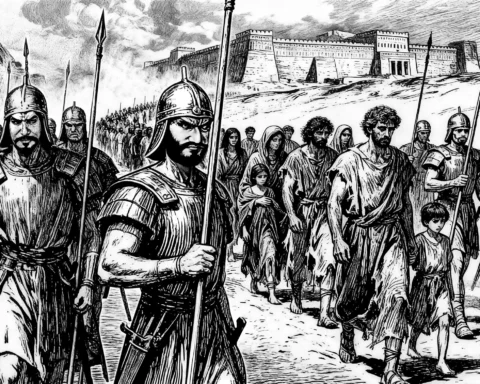
Illustration by Fiki. ©2025 ISI.BIBLE
The Lord is for me; I will not fear; What can man do to me? – Psalm 118:6
In the Book of Acts, we read about Peter being arrested, thrown into prison, and facing serious charges—and possibly the death penalty if convicted (Act 12:1–17). Yet on the very night before he was to appear before the judge for trial (and likely sentencing also), we read that Peter was sleeping soundly and peacefully. Amazing! He was resting in the supernatural “peace of God.”1 He was confident in his faith and completely trusted the Lord, regardless of the outcome. Peter had done all he could, and now things rested in God’s hands—“Your will be done” (Mat 6:10; 26:42; cf. Psa 3:4; 4:8; Pro 21:31).
Keep in mind that at that time, trials were usually conducted in a very speedy (and often unfair) manner. A death sentence was very likely if Peter was found guilty, and it would probably have been carried out almost immediately after the trial. Thus, this situation was no light matter of a civil trial or one with a lengthy appeals process with seemingly endless delays stretching over years or even decades, as is common today—it was a very swift capital punishment trial.
We should also note that the other Christians were praying fervently for Peter (Act 12:12); this is an example of how we are to conduct ourselves in this spiritual battle we are in. We can also be sure that Peter had prayed and done everything that was prudent and wise for him to do as a child of God. But here is the most important part: He trusted completely in the Lord for the outcome. Let us look to Peter’s example for inspiration and assuredness to trust in the Lord, no matter what. It may not be the Lord’s will for us to receive a miraculous deliverance as Peter did, but we are to “trust in the Lord”2 completely, at all times and in all things (Rom 14:7–8; Mat 10:29–30, 39; Php 3:7–11; Joh 12:25), and to pray for His will to be done, regardless of the outcome (Mat 6:10; cf. Mat 10:28; 26:42; Psa 56:11; 118:6).
One final note: We must remember that we are not suffering alone. We are part of the kingdom and family of God, and God is always with us, no matter where we find ourselves or what we are facing (Mat 28:20; Psa 23:4; cf. Rom 8:28–29). We see from Scripture that James was also arrested, but he didn’t receive a miraculous deliverance. He was put to death while Peter was spared. We may not always understand why things happen the way they do on this side of heaven, but we must still trust in the Lord (Isa 55:8–9; Rev 15:3; Psa 25:4; Pro 3:5; Rom 11:33).3
Wayne Jackson writes about this: [7]
We Do Not Suffer Alone
We are not the first to struggle with the mysteries of crushing blows in our lives. The early saints were similarly confronted with such hardships, and yet they maintained their faith.
During the reign of Herod Agrippa I, James, the brother of John was killed for the cause of Christ, and yet, Peter, on the same occasion was delivered from prison and spared the malicious intent of the ruler (Acts 12:1ff). Why? Surely the Jerusalem Christians puzzled over this matter.
Four companions in the gospel—Paul, Silas, Timothy, and Luke—arrive in the city of Philippi to do mission work. Two of them—Paul and Silas—are whipped and thrown into prison. The other two remain untouched. Who can explain it?
Why was it the case that Epaphroditus, Paul’s helper in Rome, who had become so desperately ill, was delivered from his illness (Php. 2:25–27), while Paul himself, who was afflicted with some grievous “thorn in the flesh,” was informed that he must abide in that condition (2 Cor. 12:7–9)?
Why these seeming inequities? We do not know. But the New Testament writers record these events with no apology. We will never be able to “figure out” why some of us today appear to have it so well, while others are forced to endure agonies. We must simply have confidence that [our] Father is working a plan that he knows far better than we. We must wait for the clearer picture.
So, brother or sister in Christ, could you sleep soundly—without anxiety, even with joy—on the very night before you were to be brought before the judge for trial and sentencing, even unto death? That gives us a level of faith to aspire to. Amen.4
CHAPTER PRAYER
All-knowing and all-seeing Father God in heaven, thank You for the gift of today and the gift of Your Son, Jesus, who died for my sins on the cross. Father, let me have the same courage, faith, peace, and joy that Peter had in prison as I face difficult circumstances. Let me rejoice when I face trials and tribulations, knowing that Your will is being done, and help me stand firm in faith and endure to the end as a good soldier in Christ. Let me also be an example for others who may be with me in times like this. I pray this through the precious blood of my Savior, Jesus. Amen.
1 → [The Peace of God]
2 → [Living in the Spirit, Trust in the Lord]
3 This footnote is written to those who find themselves behind bars. Know that you can use your time of incarceration to read and study the Word of God and then lead others to eternal life in Christ. God may have given you a “time-out,” if you will, so that you have the opportunity to come to know His Son, Jesus—and then hopefully also help others who are still lost and wandering in the darkness and “the valley of the shadow of death” (Psa 23:4) of this fallen world. You may also find our book The Gospel of the Grace of God to be helpful in leading others through the “good news” (Luk 1:19; 2:10; Act 8:12; 13:32; Rom 10:15; Heb 4:2, 6; Isa 41:27; 52:7; 61:1) of the Gospel.
4 I admit this situation would severely test the faith of even the greatest saint (and mine as well), but we must try to do as Peter did. As explained in the chapter “Living in the Spirit,” you are no longer living by your own might or power but “by the Spirit” of God abiding in you. The same Spirit of power that raised Jesus from the dead now lives in you! That is the only way we can behave like Peter did. Amen.