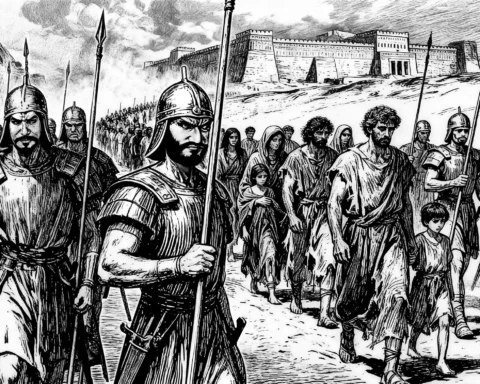
ILLUSTRATION BY FIKI. © 2025 ISI.BIBLE
Jesus said to them, “Truly, truly, I say to you,
before Abraham was born, I am.” – John 8:58
In this chapter, we will look at a critical aspect of Christian faith: Was (and is) Jesus really God? While some skeptics, agnostics, and atheists try to deny that Jesus of Nazareth (the man) ever lived (despite overwhelming historical evidence that He did), most people (but not all, of course) realize that they cannot escape the force of that evidence. So, in a continued effort to discredit God, His Son, and the Gospel, they resort to mockingly conceding, “Well, Jesus never claimed to be God. He was just a good moral teacher.” But let us look at the truth of what Scripture tells us:
- Jesus did, in fact, claim to be God many times (Mat 26:63–64; Mar 14:61–64; Luk 22:70; Joh 8:58–59; 5:18; 10:30–31; 12:45; 14:7–9; 17:21; Rev 1:17–18; cf. Mat 17:1–8; Joh 5:17, 23; 16:15; 17:10; Col 1:15–16). It’s worth noting that the Jews of Jesus’ day had no misunderstanding about this. Each time He claimed to be God, they tried to stone Him to death (Joh 5:18; 8:59; 10:30–33).
- God the Father declared Jesus to be God (Mat 3:16–17; 17:5; Mar 9:7; Luk 3:22; 9:35; Joh 5:32, 37; 2Pe 1:17; Heb 1:8; 5:5–6; cf. Luk 1:35; Act 10:38; Rom 1:4).
- Scripture, written under inspiration of the Holy Spirit, declares that Jesus is God in several ways as follows:
- Directly associating Jesus with God (e.g., Col 1:15–16; 2:9; Joh 1:1–3; Heb 1:1–8; 1Jn 5:20; Luk 24:27; Joh 5:39; Psa 110).
- Several NT authors (John, Paul, Peter, along with the writer of Hebrews) explicitly refer to Jesus as God,1 and all use titles and language that associate him with the God of Israel (Lord, YHWH) (e.g., Joh 1:1; 20:28; Rom 9:5; Tit 2:13; 2Pe 1:1; Heb 1:8).
- NT writers repeatedly apply the Greek word for “Lord”2 and other divine prerogatives to Jesus (e.g., Rom 10:9–13; Php 2:10–11; Heb 1:10–12; Rev 1:17; 22:13).
- Texts that apply to the eternally existing God in the OT (Lord, YHWH, Jehovah/Yehovah) are also applied to Jesus:3
- Calling on the name of the Lord (YHWH) is equated with calling on (confessing) Jesus (Joe 2:32 Cf. Rom 10:9–13).
- Every knee will bow and every tongue will confess the Lord (YHWH) is applied to Jesus (Isa 45:18–23 Cf. Php 2:10–11).
- Preparing the way of the Lord (YHWH) is applied to Jesus (Isa 40:3 Cf. Mat 3:3; Mar 1:2–3; Luk 3:4–6).
- “The first and the last” is associated with both the Lord (YHWH) and Jesus (Isa 41:4; 44:6; 48:12 Cf. Rev 1:17; 22:13).
- Both the Lord (YHWH) and Jesus (the Son) are identified as the eternal Creator (Psa 102:25–27 Cf. Heb 1:8–12).
- Hearing but not believing is tied to both the Lord (YHWH) and Jesus, and John explicitly identifies the glory Isaiah saw as the glory of Christ (Isa 6:1–10 Cf. Joh 12:37–41).
- Paul states that the spiritual Rock is Christ (Deu 32 Cf. 1Co 10:4).
- The disciples (and others) declared Jesus to be God (Mat 14:33; 16:16; 27:54; Mar 8:29; 15:39; Joh 11:27; 20:28).
- Several attributes are ascribed to Jesus that can only belong to deity: eternal being, holiness, and receiving “worship” (see Mat 2:2, 11; 4:10; 28:9; Luk 4:8; 24:52; Joh 4:23–24; 9:38; Act 16:14; 18:7; Rom 12:1; Php 2:10; 3:3; Rev 5:14; cf. Heb 12:28; Psa 29:2; 66:4; 95:6; 96:9; Job 1:20–21; Rev 19:4). Scripture assigns all of these attributes to Jesus.
- Speaking of His eternal nature, Scripture makes it clear that Jesus has no beginning and no end. The Bible tells us that “He [Jesus] was foreknown before the foundation of the world” (1Pe 1:20), that “He [Jesus] was in the beginning with God” (Joh 1:2), that He (Jesus) “was with God” (Joh 1:1), and that He (Jesus) “was God” (Joh 1:1). Scripture further states that “all things came into being through Him [Jesus]” (Joh 1:3). He has coexisted eternally with God the Father from eternity past,4 and He will continue to exist for eternity future (e.g., the “first and the last,” the “Alpha and Omega,” the Great “I AM”; see Rev 1:17–18; 1:8; 21:6; 22:13; Joh 8:58; cf. Exo 3:14; Heb 13:8; Rev 2:8; Col 1:15).5
- Only God can forgive sins, and Jesus did just that (Mat 9:2–5; Luk 5:20; 23:43; Joh 8:11). Scripture tells us that “all authority” was given to Him by God the Father (Mat 28:18; cf. Mat 11:27; Luk 10:22; Joh 3:35; 5:22–27; 13:3; 17:2; Rom 14:9; 1Co 15:27; Eph 1:20–22; Php 2:9–11; Col 1:16–19; Heb 1:2; 2:8; 1Pe 3:22; Rev 11:15; 19:16). It is only through Jesus that one can receive forgiveness of sins and be saved (Joh 10:1–9; 14:6; Act 4:12; 1Ti 2:5). Additionally, recall from previous chapters that Jesus (as God) will be your Judge on the great Day of Judgment, for “He [God] has given all judgment to the Son” (Joh 5:22).
- The works and miracles He performed, which were witnessed by hundreds and thousands of people, demonstrated that He was God (Mat 8:5–13, 28–34; 9:1–8, 18–26, 27–31, 32–33; 12:10–13, 22; 15:22–28; 17:14–18; 20:30–34; Mar 1:23–28, 30–31, 40–45; 7:31–37; 8:22–26; Luk 7:11–17; 8:43–48; 13:10–17; 17:11–19; 22:50–51; 24:5–6; Joh 4:46–53; 5:1–9, 36–37; 9:1–38; 11:1–46; 20:30–31; 21:25).
- His command over nature confirmed that He was God (Mat 8:23–27; 14:15–33; 15:32–38; 21:18–19; Mar 4:36–41; 11:20–21; Luk 5:1–8; 8:22–25; Joh 2:1–11; 21:1–14).
- The many prophecies He fulfilled, which were written many years before He was born, further proved that He was, in fact, God in the “flesh” (Joh 1:14; Rom 1:3–4; 8:3; 1Ti 3:16; Heb 2:14–17; 1Jn 4:2–3; 2Jn 7; cf. Mat 1:20–23; Gal 4:4; Php 2:5–8; Col 2:9; Heb 2:7–9; Isa 7:14).6, 7
- Even more astonishing is the fact that the “demons” knew exactly who Jesus was and proclaimed so, for they clearly identified Him as “Jesus, Son of the Most High God” (Mar 5:7; Luk 8:28; cf. Mar 1:24, 34; 3:11; 5:7; Luk 4:34; 4:41; Act 19:15; Jas 2:19), and they did so without any ambiguity or doubt whatsoever! They also understood that they were under His full authority, command, and judgments (Luk 8:26–33; 10:17; Mat 8:28–34; Mar 5:7; Jas 2:19; cf. Mat 25:41; Jud 6; Rev 20:10; Heb 2:8).
- And lastly, His resurrection from the dead proved beyond a shadow of a doubt that He was, and is, God (Rom 1:4; Act 17:30–31; Eph 1:19–21; 1Pe 1:3–5, 20–21; 1Co 15:3–8, 12–19; Rom 6:4; Act 2:22–24). What’s more, Jesus even foretold both His death and resurrection.8
Note that the name Jesus used most often when referring to Himself was “the Son of Man” (Mat 8:20; 9:6; 10:23; 13:37; Act 7:56; etc.); this reinforces His love, affection, and bond with humanity and the value He places on His own humanity (despite also being God). Jesus will be identified with His (and our) humanity for all eternity. Amazing!
In the next chapter, we further examine a matter of monumental and eternal importance: Was Jesus really raised from the dead? For without His resurrection, we would have no “good news” and no “hope” of eternal life (1Co 15:12–20).9
[1] From the Greek theos (θεός, G2316), which means God or deity.
[2] The Greek translation of the OT (the Septuagint [LXX]) used kurios (κύριος, G2962) for Lord (YHWH).
[3] This is only a partial list. See also → [There Is a God § The Name of God] for a discussion of Lord, YHWH, Jehovah, I AM, and how the name of the Lord is rendered in the OT (Hebrew) and NT (Greek).
4 Please don’t take this to mean the “Eternal Sonship” dogma of the Nicene Creed; that is another false teaching of man.
5 Jesus is not “a created being,” “a fallen angel,” or “the brother of Satan,” as some so-called “Christian” churches claim—such is all blasphemy.
6 See also Isa 7:14; 9:6–7; 50:6; 53:1–12; 61:1–3; Dan 7:13–14; Jer 23:3–6; Zec 9:9; Psa 22:14–18; 34:20; 118:22–29; Mal 4:5 and → [Bible Prophecy Foretold Jesus]
7 → [Our Hope] for verse references about God in the flesh.